Installation
How Long Does AD Installation Take?
Plant erection and total project duration aren't the same thing. Here's the general sequence a farm AD build moves through, and what actually drives the timeline.
8 min readRead Guide

A finished AD installation is the result of several distinct stages, not just the digester arriving on site. Here's what's actually involved, and why coordination matters as much as any single trade.
10 min read · Reviewed September 2026
Quick Answer
Installing a farm anaerobic digestion plant involves considerably more than delivering the digester itself. The complete project can include site assessment, layout planning, groundworks, concrete, tanks, trenches, pumps, mixers, pipework, electrical services, equipment installation, testing and commissioning. The exact scope depends on the farm, the plant and how much work the farmer wants to undertake themselves.
Key Points
When people picture an AD installation, they often picture the finished digester. But before the plant reaches that point, considerable work may already have taken place — the exact sequence depends on the system and site, but a typical farm project moves through a broad set of stages, several of which can overlap rather than strictly following one another.
The first stage is understanding the site — cattle housing, slurry collection, existing tanks, access, available land, ground levels, drainage, electrical services, existing buildings and the proposed plant location. This is where practical agricultural experience matters: an arrangement that looks neat on a drawing may create problems once tractors, tankers, loaders, cattle movements and maintenance access are considered.
Once the farm is understood, the installation requirements can be developed — digester, CHP, pumps, mixers, tanks, separator, pipework, valves, cabling, control equipment, concrete, drainage and trenches. The aim is to understand the whole installation, not merely the main AD unit.
Charlie Bell Building deliberately works with flexible project scopes. One farmer may have their own excavator, staff, groundwork contractor or electrician and want CBB to undertake only selected specialist work. Another may want CBB to coordinate substantially more. What matters is establishing clearly what CBB is doing, what the farmer is doing, what the plant manufacturer is doing, and what specialist contractors are doing — ambiguous responsibility is one of the easiest ways to create project delays.
The plant arrangement needs to work physically — slurry source, transfer distance, digestate route, tanks, pipework, electrical services, maintenance access, vehicle access, levels, drainage and future development all need balancing against each other.
Procurement can't wait until the site is ready, either. Some equipment — pumps, mixers, control panels, concrete products, fabricated steel, specialist valves — can have significant manufacturing or delivery lead times, so procurement and construction need to progress as coordinated workstreams rather than one after the other.
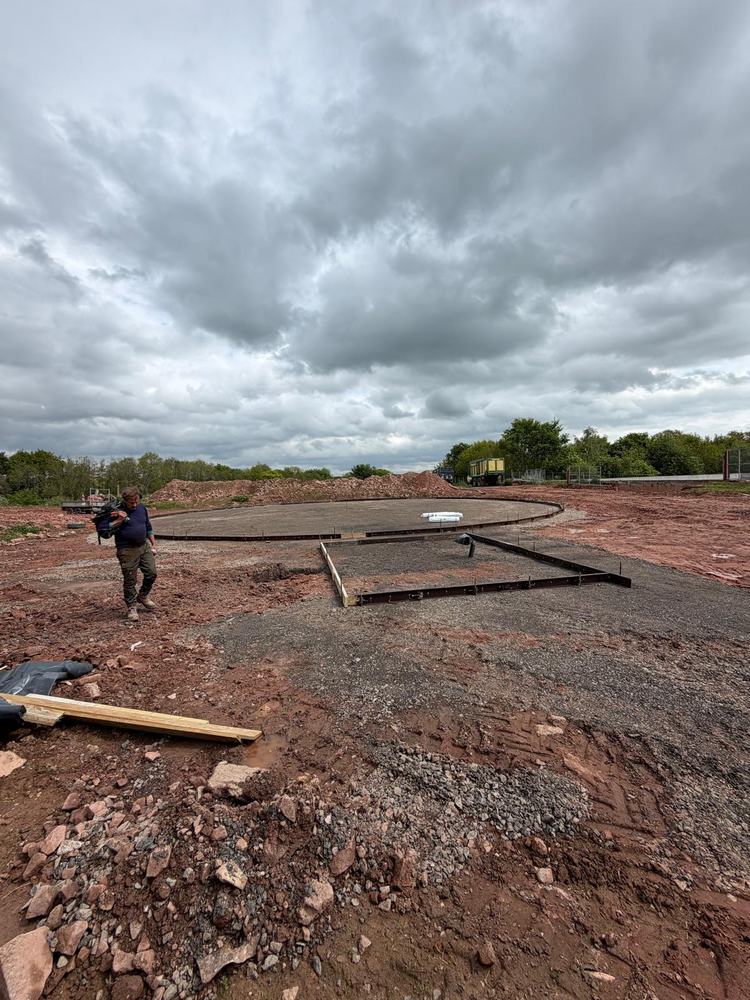
Physical works can then begin — clearing, excavation, stone or sub-base, levelling, trenches, tank excavations, drainage and access preparation. Accurate preparation matters because later equipment relies on the levels and positions established at this stage.
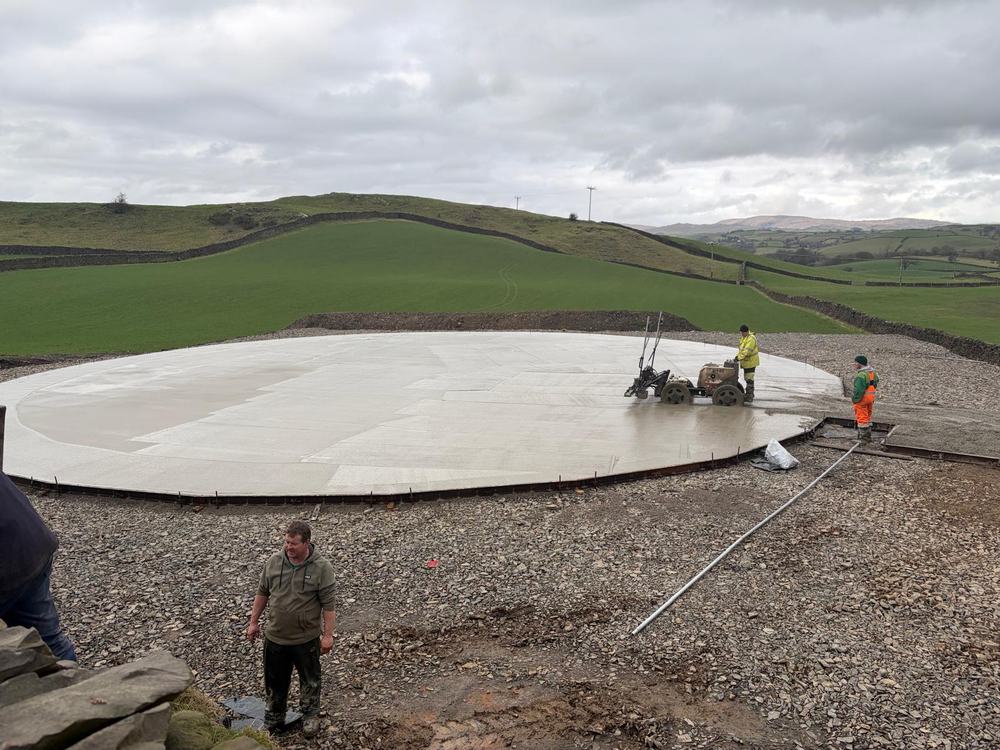
Concrete for plant foundations, equipment bases, tank structures and associated infrastructure has to be formed, poured, finished and cured sufficiently before subsequent work — a delay here can affect everything scheduled afterwards.
Depending on the installation, tanks may be required for slurry transfer, reception, digestate and associated process duties, with fabricated steelwork, concrete panels and other components coordinated between suppliers. Pumps are fundamental to most farm AD installations, transferring material between slurry collection, reception, the digester, digestate storage and any separation equipment — correct selection and installation matter because these components operate in demanding environments.
Pipework connects the physical system, with routes needing to consider distance, elevation, access, protection, valves, crossings and future maintenance. Buried pipework may need to be installed while trenches are open, which makes sequencing important.
Electrical specialists may install power cabling, control cabling, containment, panels, instrumentation, CHP connections and pump or mixer supplies. CBB's role is best understood as coordinating and enabling electrical requirements where appropriate, alongside its own core groundworks and mechanical installation work, rather than every element being performed by any single party.
Once the enabling work is sufficiently complete, the principal plant equipment can be delivered — and modern modular AD equipment can sometimes be installed surprisingly quickly once the site is ready. At Jenkin Cragg Farm near Kendal, covered by Farmers Weekly in March 2026, the Biolectric plant components were manufactured in Belgium before being shipped to the UK, with the reported on-site construction of the plant itself taking around four days. The same article credits Charlie Bell as the project manager who guided the farmer and oversaw the groundworks.
That example illustrates an important distinction: fast equipment erection depends on the site being properly prepared first — the four days is the visible final step of a much longer planning and groundworks process, not the whole project.
The plant then needs to be integrated with slurry infrastructure, digestate storage, pumps, pipework, the electrical system, controls and gas utilisation equipment — this integration is what turns a collection of components into a functioning installation.
Before normal operation, systems need to be checked and commissioned. Responsibilities for this can be shared between CBB, the plant manufacturer, electrical specialists and other parties depending on the agreed scope for that project — the exact split is confirmed on a project-by-project basis rather than fixed in advance.
Potentially quite a lot. A farm with appropriate machinery, labour and local contractors may want to undertake excavation, stone preparation, certain trenching or some general construction themselves. Other farmers may prefer CBB to undertake or coordinate more. That's why the approach is as much or as little support as the project requires, rather than a rigid installation package.
An AD project can involve the farmer, CBB, the plant manufacturer, pump suppliers, concrete suppliers, fabricators, hauliers, electrical contractors, groundwork contractors and equipment suppliers. If one item is late, several later activities can be affected — good installation management involves looking several weeks ahead, not simply reacting to today's work.
Sources
How Long Does AD Installation Take?
Plant erection and total project duration aren't the same thing. Here's the general sequence a farm AD build moves through, and what actually drives the timeline.
What Groundworks Does AD Need?
Almost everything else in an AD installation depends on the groundworks being right — levels, foundations, drainage, service routes and future maintenance access.
AD Installation Readiness Checklist
A practical, section-by-section checklist covering scope, site, concrete, slurry, pipework, electrical, equipment, logistics and outstanding decisions.
Common AD Installation Problems
Most installation delays trace back to something outside the digester itself — late decisions, incomplete groundworks or an unclear division of responsibility.
Charlie Bell Building supports farm-scale anaerobic digestion installations from site preparation and groundworks through to equipment installation and commissioning support.