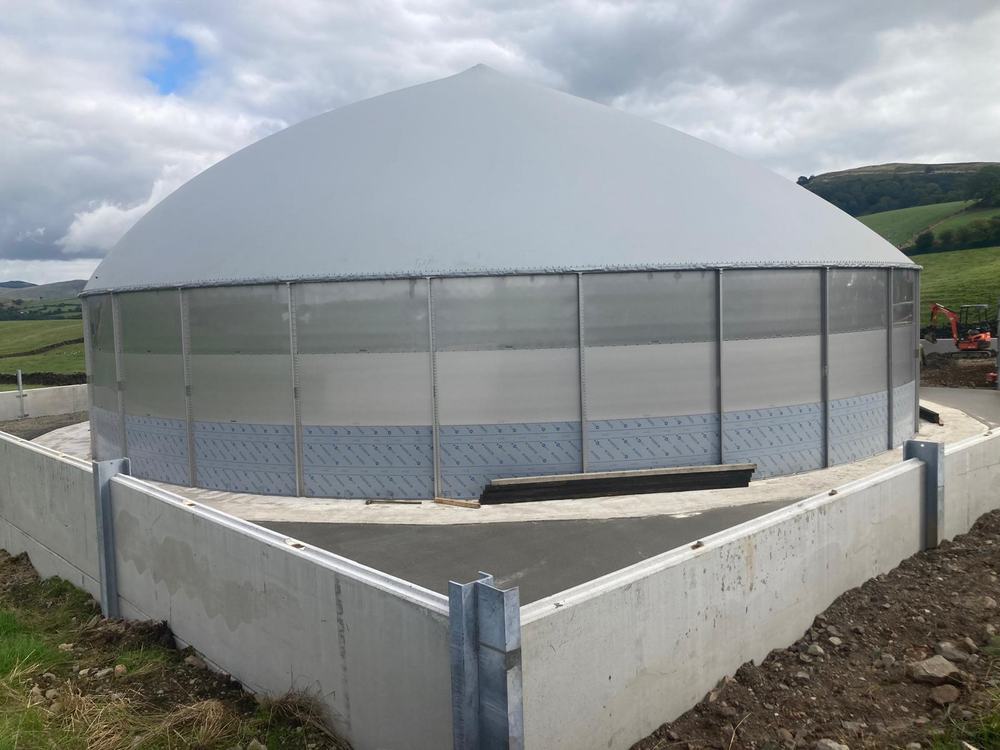
Equipment
What Size Digester Do I Need?
Digester size can't be calculated from cow numbers alone — it depends on feedstock volume, dry matter, retention time and the farm's actual energy demand.
9 min readRead Guide

It's a simple-sounding question with a more nuanced answer — output depends on feedstock, methane content and CHP efficiency together, not a fixed per-cow figure.
8 min read · Reviewed September 2026
Quick Answer
The electricity produced by a farm anaerobic digestion plant depends on the amount and energy content of the feedstock, biogas yield, methane concentration, generating equipment and plant operating conditions. There is no reliable universal figure for electricity per cow. The best systems are sized using actual farm feedstock and energy data, rather than herd size alone.
Key Points
Strictly speaking, the digester doesn't — it produces biogas. The energy conversion chain runs from feedstock, through anaerobic digestion, to biogas, then through a CHP unit to electricity and heat. Biogas contains methane, which can be burned as fuel, and government farm energy guidance describes typical biogas as roughly 60% methane and 40% carbon dioxide, although actual composition varies by feedstock and digester conditions.
CHP means combined heat and power. Instead of using fuel only to generate electricity and rejecting the remaining thermal energy, CHP recovers useful heat as well. This means the energy value of an AD plant shouldn't necessarily be assessed from electrical output alone — if the recovered heat can be used effectively, it contributes additional value beyond the electricity figure.
Kilowatts (kW) describe the rate at which power is being generated or consumed at a particular moment — a 40kW generator operating at full output is producing electricity at a rate of 40kW. Kilowatt-hours (kWh) describe the quantity of energy generated over time: that same 40kW generator running at full output for 10 hours produces 400kWh. Real plants don't necessarily run continuously at nameplate output, so annual generation depends on actual operating hours, not just the capacity rating.
Several stages affect the final result: how much suitable feedstock is available, its quality (a tonne of dilute slurry doesn't contain the same biodegradable energy as a tonne of higher-energy material), the biogas yield and methane content that result, and how well the digester itself performs — temperature, loading, mixing and biological health all affect gas production.
CHP efficiency is another factor — only part of the chemical energy in the gas becomes electricity, with more recovered as heat. And the AD installation itself consumes some electricity for pumps, mixers, controls and other auxiliaries (sometimes called the parasitic load), so the electricity available to the wider farm isn't identical to gross generator output.
This sounds like an attractive metric, but it can be misleading. Different farms have very different manure collection rates, housing periods, slurry dilution, dry matter, feeding systems and storage arrangements — a cow grazing outdoors doesn't provide the digester with the same collectable feedstock as an equivalent housed animal. For this reason, a fixed kWh-per-cow figure shouldn't be treated as a design guarantee.
Many dairy farms have significant and reasonably continuous electrical demand — milking equipment, robotic milkers, milk cooling, refrigeration, vacuum pumps, water heating, ventilation and slurry handling all draw power. That creates the potential for electricity to be used where it's generated, which matters commercially because on-site generation can displace purchased electricity.
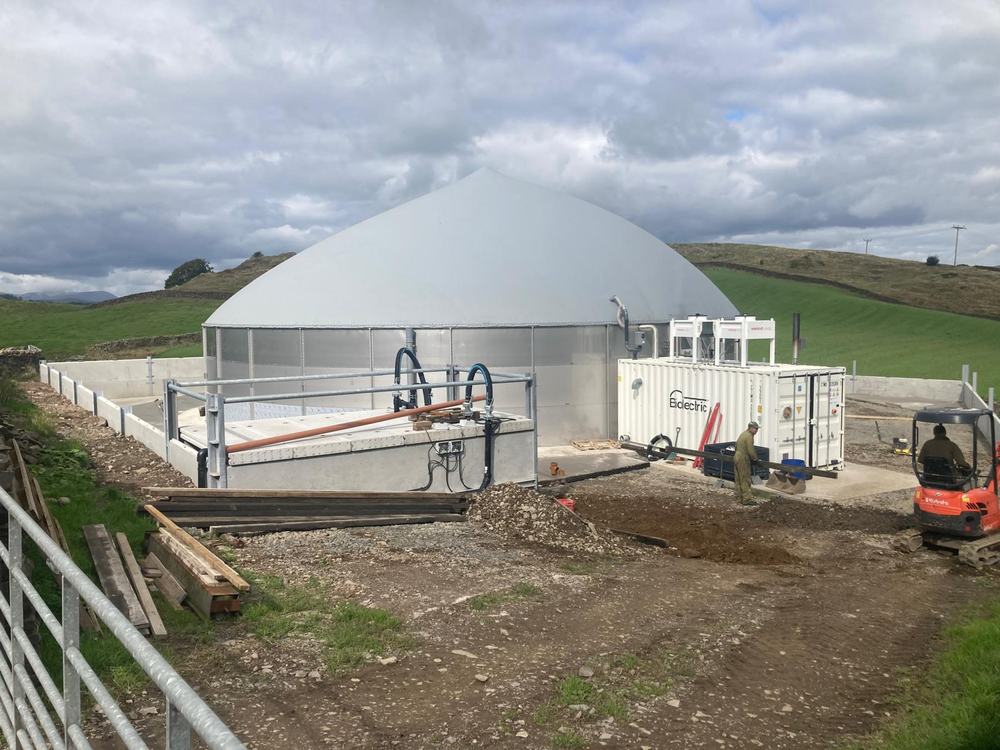
A March 2026 Farmers Weekly report covers a slurry-fed Biolectric AD installation at Jenkin Cragg Farm near Kendal, Cumbria, run by John and Nicola Young — Farmers Weekly's 2025 Dairy Farmers of the Year. The farm milks 550 pedigree Holsteins, and the AD plant is expected to use around 70% of the herd's slurry.
The farm already had a 75kW rooftop solar system, installed in 2018, providing around 30% of its electricity. Once the AD plant is running, the farm expects all its electricity to be produced on site, with roughly 35kW of surplus exported to the grid. This is one specific, well-documented example, not a universal formula — it illustrates how AD can form part of a broader farm energy strategy rather than necessarily replacing every other technology.
Solar output depends on available sunlight. Biogas production can provide a more controllable energy source, because stored biological energy is being converted through the digester and CHP on an ongoing basis — which can be particularly useful where a farm has significant electricity demand outside peak solar generation hours. That doesn't make AD universally 'better' than solar; the technologies have different capital costs, maintenance requirements, space requirements and generation profiles, and can also complement each other.
Potentially, yes, subject to the electrical connection, commercial arrangements and applicable requirements. In England, the Environment Agency's guidance for qualifying T24 farm AD systems explicitly recognises burning biogas to provide farm power or export electricity to the National Grid — Scotland's equivalent position sits with SEPA. Grid connection capacity should nevertheless be investigated early, rather than assumed.
Not necessarily the highest one available. The better question is what output best matches the farm's feedstock resource and energy profile — an oversized generator that can't be fed consistently, or whose electricity can't be used effectively, may offer less value than a smaller, well-utilised system.
Sources
What Size Digester Do I Need?
Digester size can't be calculated from cow numbers alone — it depends on feedstock volume, dry matter, retention time and the farm's actual energy demand.
Is AD Worth It for a Dairy Farm?
AD can make sense for dairy farms with reliable slurry, sustained energy demand and a suitable site — but there's no universal return. Here's what actually drives it.
Can AD Run on Slurry Alone?
Yes — slurry-only AD is already operating on UK dairy farms. Here's what affects gas production, how slurry actually moves through the system, and what it needs to work well.
How Many Cows Do You Need?
Herd size is only a starting point. What matters more is how much slurry can actually be collected, how consistently, and the farm's energy demand.
Charlie Bell Building supports farm-scale anaerobic digestion installations from site preparation and groundworks through to equipment installation and commissioning support.